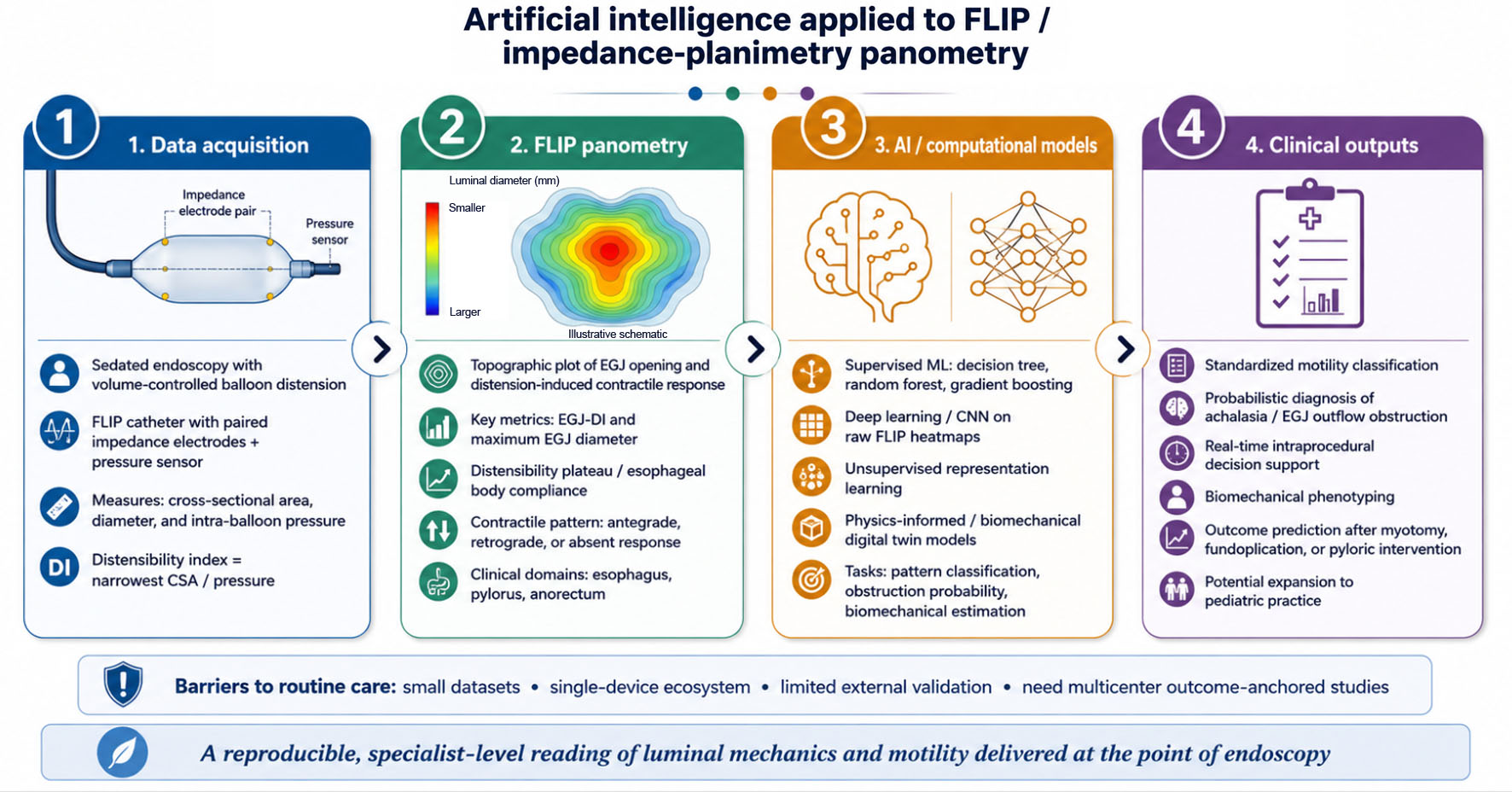
| Part A. Studies using functional lumen imaging probe or impedance-planimetry data (direct evidence) |
| Carlson et al [20], 2021 | Single center; FLIP panometry; retrospective | Supervised decision tree and random forest on engineered contractility and pressure features; identify achalasia subtypes | 180 patients | Internal; training and held-out test split of the same cohort | Manometric achalasia subtype (Chicago Classification) | Type III vs non-spastic 90% (train)/78% (test) accuracy | Small single-center cohort; discrimination among individual subtypes limited; dependent on hand-engineered features; no external validation and no outcome endpoint |
| Schauer et al [24], 2022 | Single center; FLIP metrics; retrospective | Bayesian additive regression trees; estimate probability of EGJ obstruction | 557 patients + 35 controls | Internal; leave-one-out evaluation with a holdout test set, both from the same cohort | Expert-assigned diagnosis of EGJ obstruction based on HRM and complementary clinical testing | Accuracy 89–90%; AUC 0.95–0.97 | Discrimination reported without calibration; single center; expert-defined reference rather than treatment response; no external validation |
| Halder et al [25], 2022 | Single center; FLIP panometry processed through a one-dimensional inverse mechanical model | Variational autoencoder over mechanics-based parameters; unsupervised mapping of esophageal disorders onto a virtual disease landscape | Cohort spanning motility disorders, eosinophilic esophagitis, reflux disease, and scleroderma esophagus | Internal; latent-space clustering compared with established diagnostic categories | Existing clinical diagnostic categories (model itself unsupervised) | Disorders occupied distinguishable regions of the landscape; disease progression over time and treatment effect displayed for individual patients | Proof of concept; no independent clinical endpoint; treatment-effect demonstration illustrative |
| Kou et al [21], 2023 | Single center; raw FLIP output rendered as panometry heatmaps | Convolutional neural network (deep learning); classify esophageal motility | 678 patients + 35 controls | Internal; held-out evaluation within the same cohort | Expert panometry interpretation, with HRM for achalasia | 89% accuracy in each binary stage vs experts; 93% of 28 HRM-confirmed achalasia test cases identified | Agreement with expert labels rather than clinical outcome; single center and single probe platform; limited interpretability; no external validation |
| Halder et al [27], 2024 | Single center; FLIP panometry; retrospective | Mechanics-based parameters, variational autoencoder, and linear discriminant analysis; assign diagnostic probabilities on the virtual disease landscape | 740 subjects | Internal; comparison with FLIP and HRM diagnoses in the same cohort | Expert FLIP and HRM (Chicago Classification) diagnoses | Separation of normal EGJ opening from EGJ obstruction aligned closely with both FLIP and HRM diagnoses | Single center; expert-label target; no withheld-center or outcome validation |
| Fass et al [22], 2025 | Single center; FLIP panometry heatmaps; retrospective | Transformer deep-learning classifier trained to panometry classification v2.0; classify motility as normal, “achalasia” (including conclusive EGJ outflow obstruction), or abnormal | 985 patients (719 training, 127 validation, 139 test) | Internal; patient-level training, validation, and test split without patient overlap | Blinded expert diagnosis from HRM (Chicago Classification v4.0), with record review and timed barium esophagram where inconclusive | 84% accuracy on the test set versus 71% for the earlier convolutional model; PPV 91% for normal motility and 84% for achalasia | Research letter with limited methodological detail; single center; single platform |
| Halder et al [28], 2025 | Single center; FLIP panometry; software framework | Web framework combining clinical metrics, mechanics-based metrics, and virtual-disease-landscape probabilities | 121 subjects | Internal; framework output compared with expert categorization | Expert clinician categorization of EGJ opening | Framework metrics matched expert diagnosis; misclassifications few and mainly between adjacent categories | Small validation set; single center; expert-label target; tool validation rather than clinical evaluation |
| Mascarenhas et al [23], 2026 | Multicenter (EU + US); FLIP panometry | Multiple ML classifiers (AdaBoost, random forest, gradient boosting); classify panometry per Dallas Consensus | 105 exams, five centers | Internal; patient-level training and testing split within the pooled multicenter sample (not center-level external validation) | Expert Dallas Consensus classification | Accuracy 84.9–86.7%; AUC 0.89–0.97 (Results/Table 1 of ref. [23]) | Small number of examinations; no withheld center for external testing; single commercial platform; expert labels rather than outcomes |
| Part B. Related studies using other modalities (indirect evidence) |
| Kou et al [26], 2021 | Single center; raw HRM swallows | Variational autoencoder (unsupervised); learn motility representations | > 32,000 swallows | Internal; reconstruction and latent-space assessment | None (unsupervised; latent features compared with established manometric metrics) | Latent features encoded contraction strength, propagation, relaxation | HRM rather than FLIP; no diagnostic or clinical validation; latent features not linked to management decisions |
| Halder et al [29], 2023 | Mechanics-informed MRI of the esophagus | Physics-informed neural network; estimate wall stiffness and active relaxation | 1 healthy volunteer | Internal; physical-consistency and simulation checks | Model-based mechanical quantities and MRI-derived measurements | Recovered esophageal mechanical properties and missing LES data | Imaging modality other than FLIP; feasibility stage; very small sample; no clinical endpoint |
| Wang et al [30], 2021 | HRM dataset (context) | 3D CNN + bidirectional ConvLSTM; classify esophageal motility over time | HRM dataset, single source | Internal validation | Expert HRM classification | 91.3% accuracy; 90.5% sensitivity; 95.9% specificity | HRM rather than FLIP; single data source; expert labels; no external or outcome validation |
| Mascarenhas et al [31], 2025 | Multicenter, multidevice HRM (context) | Gradient boosting/xGB; detect Chicago Classification disorders | 618 exams, three centers | Internal cross-validation across pooled multidevice data | Chicago Classification v4.0 expert labels | EGJ outflow accuracy 0.942; AUC 0.921 | HRM rather than FLIP; internal rather than held-out-center validation; expert labels rather than outcomes |