


Artificial Intelligence in Functional Lumen Imaging Probe Panometry: Toward Automated Functional and Biomechanical Endoscopy
DOI:
https://doi.org/10.14740/ctm8Keywords:
Artificial intelligence, Machine learning, Functional lumen imaging probe, Impedance planimetry, Esophageal motilityAbstract
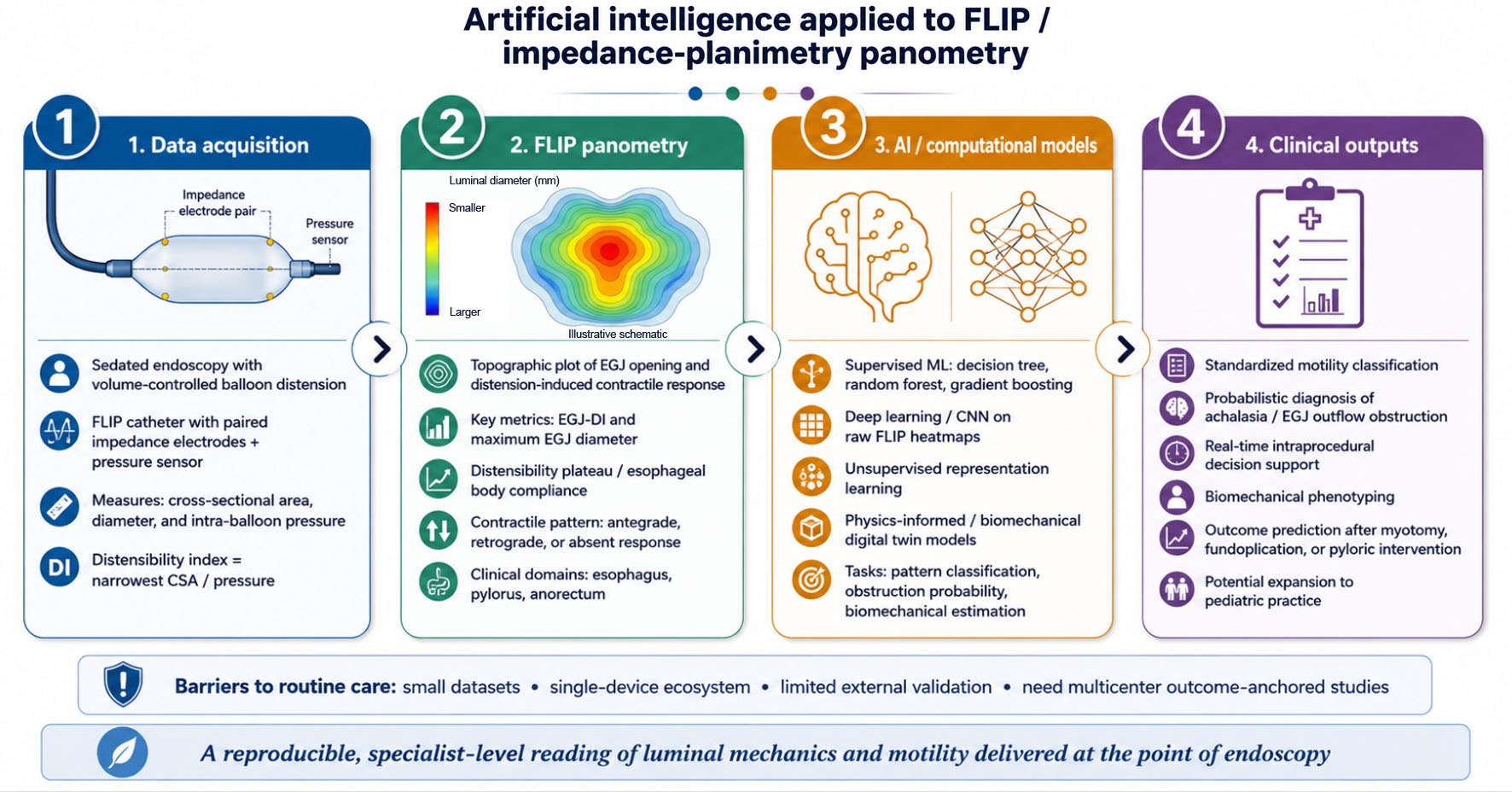
Background: The impedance planimetry-based functional lumen imaging probe (FLIP) is used to quantify luminal diameter, distensibility, and distension-induced motor activity during sedated endoscopy. FLIP panometry has become a useful adjunct to high-resolution manometry for evaluating esophageal motility, the esophagogastric junction (EGJ), the pylorus, and the anorectum. However, its interpretation is technically challenging, operator-dependent, and reliant on evolving classification schemes, limiting its dissemination beyond expert centers. Artificial intelligence (AI) may provide a means to automate and standardize this interpretation, although its application to FLIP remains in its infancy and is fragmented.
Methods: We conducted a selective, non-systematic narrative review. PubMed, Scopus, Web of Science, and Embase were searched from inception to June 2026, with the search updated to September 2026 at the time of revision, using combinations of terms related to FLIP, EndoFLIP, impedance planimetry, panometry, and distensibility, with terms related to AI, machine learning, deep learning, and relevant disease entities. The core search strategy, the eligibility criteria, and the distinction drawn between direct FLIP-based evidence and related indirect evidence are reported in the Methods. Reference lists were manually searched, and peer-reviewed articles with retrievable full text were prioritized. Because the evidence was heterogeneous and predominantly derived from small single-center studies, the findings were synthesized qualitatively rather than quantitatively pooled, and no study-selection flow diagram or formal risk-of-bias appraisal is presented.
Results: Supervised and deep-learning models can classify FLIP panometry patterns of EGJ opening and the contractile response with accuracies approaching those of expert interpreters, distinguish achalasia subtypes, and provide probabilistic diagnoses. Unsupervised representation learning and mechanics-informed models applied directly to FLIP output extend the analysis from pattern recognition toward biomechanical phenotyping, and have been used to display disease progression and to follow patients after treatment. Emerging research links intraprocedural distensibility to surgical and endoscopic outcomes, and the same computational methods are being investigated for the pylorus, anorectum, and pediatric practice. Across studies, datasets are small, derived from a single device manufacturer, and rarely externally validated; almost none are benchmarked against clinical outcomes rather than expert labels. Agreement with expert readers is not, however, equivalent to demonstrated patient benefit.
Conclusions: AI is closely aligned with the principal limitations of FLIP panometry (interpretive complexity and limited access to expertise) and could transform a niche test into a standardized, real-time decision-support tool. Realizing this potential will require multicenter datasets that span acquisition protocols, probe configurations, and successive versions of the panometry classification, external validation with explicit assessment of calibration, transparent models, and prospective, outcome-anchored studies.
Published
Issue
Section
License
Copyright (c) 2026 The authors

This work is licensed under a Creative Commons Attribution-NonCommercial 4.0 International License.